
Blog
Operating Model
A Practical Guide to Moving AI from Strategy to Production
A practical guide for enterprise leaders on why AI initiatives stall before production and what it takes to operationalize AI with reliability, ownership, and measurable impact.
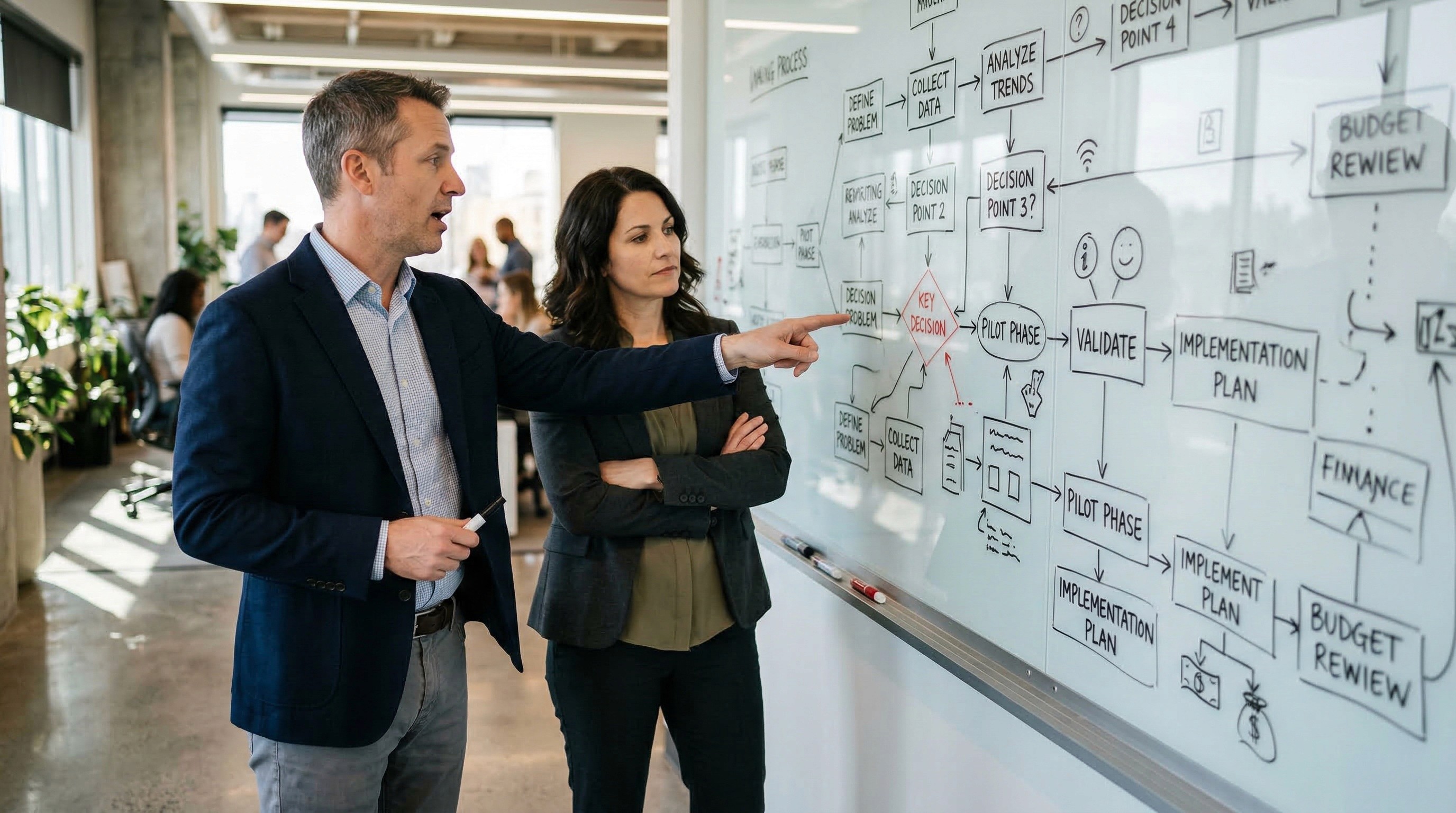
Artificial intelligence is no longer an exploratory topic for executive teams. AI strategies are defined, budgets are allocated, and expectations are set. Yet despite this, a large share of AI initiatives still fail to reach production, and even fewer deliver sustained business results. The problem today is not ambition or vision. It is execution.
In many organizations, AI strategy focuses on future potential, while production requires clarity on what can operate reliably within real organizational constraints. When this gap is not addressed, initiatives stall. Pilots remain isolated, ownership becomes unclear, and solutions never integrate into everyday operations. What was intended to drive transformation ends up existing on the margins.
This breakdown most often happens when AI is treated as an innovation exercise rather than a core business capability. Pilot projects are built outside existing systems, responsibility is diffused across teams, and technical outputs instead of business outcomes measure success. Without accountability, integration, and operational discipline, AI remains fragile and difficult to scale.
The shift begins when organizations stop asking whether AI is impressive and start asking whether it is operational.
What production-ready AI actually looks like
Production AI is not defined by model sophistication or technical novelty. It is defined by reliability, clarity of ownership, and measurable impact. AI must fit naturally into existing workflows, operate under clear governance, and deliver outcomes that leadership can explain, track, and defend over time.
This requires a different mindset. Instead of treating AI as a sequence of projects, organizations must design it as part of the operating model. That means being explicit about who owns performance in production, how success is measured, and how AI interacts with real systems, real data, and real people.
When these foundations are missing, AI initiatives tend to remain stuck in pilot mode. Prolonged experimentation often increases risk rather than reducing it. Responsibility becomes blurred, systems grow disconnected, and leaders lose visibility into what AI is actually doing. The result is hesitation, not scale.
Where AI actually starts delivering value
AI creates value only when it becomes part of daily operations. That happens when it is managed like any other critical business system, integrated into how work actually gets done, and measured against concrete business results such as cycle time, cost, risk exposure, and decision speed.
For C-level leaders, this reframes the conversation. The focus shifts away from technical detail and toward outcomes, timelines, and control. Production-ready AI must deliver impact within a reasonable timeframe, while remaining transparent enough to withstand internal reviews, regulatory scrutiny, and board-level questions.
Speed does not require sacrificing control. In fact, initiatives designed with governance, oversight, and performance tracking from the start tend to move faster. Clear ownership shortens feedback loops, reduces friction, and allows organizations to improve continuously instead of restarting with each new use case.
When AI successfully reaches production, it no longer feels experimental. It becomes part of how the organization operates. Teams rely on it, decisions improve, and value becomes visible through results rather than explanations.
The move from strategy to production is where AI either becomes a competitive advantage or a sunk cost. Organizations that succeed are not those with the most ambitious ideas, but those that execute with discipline and focus. For leadership, the conclusion is straightforward: AI creates value only when it is put to work.
Share
Subscribe for updates
Stay updated with the latest product news and exclusive behind-the-scenes insights.