

Blog
Insights
Fragmented Data, Fragmented AI: Why the Integration Layer Is the Real Bottleneck in Manufacturing
78% of manufacturers have automated less than half their critical data transfers. The AI model isn't the problem. The gap between ERP, MES, and shop floor is.
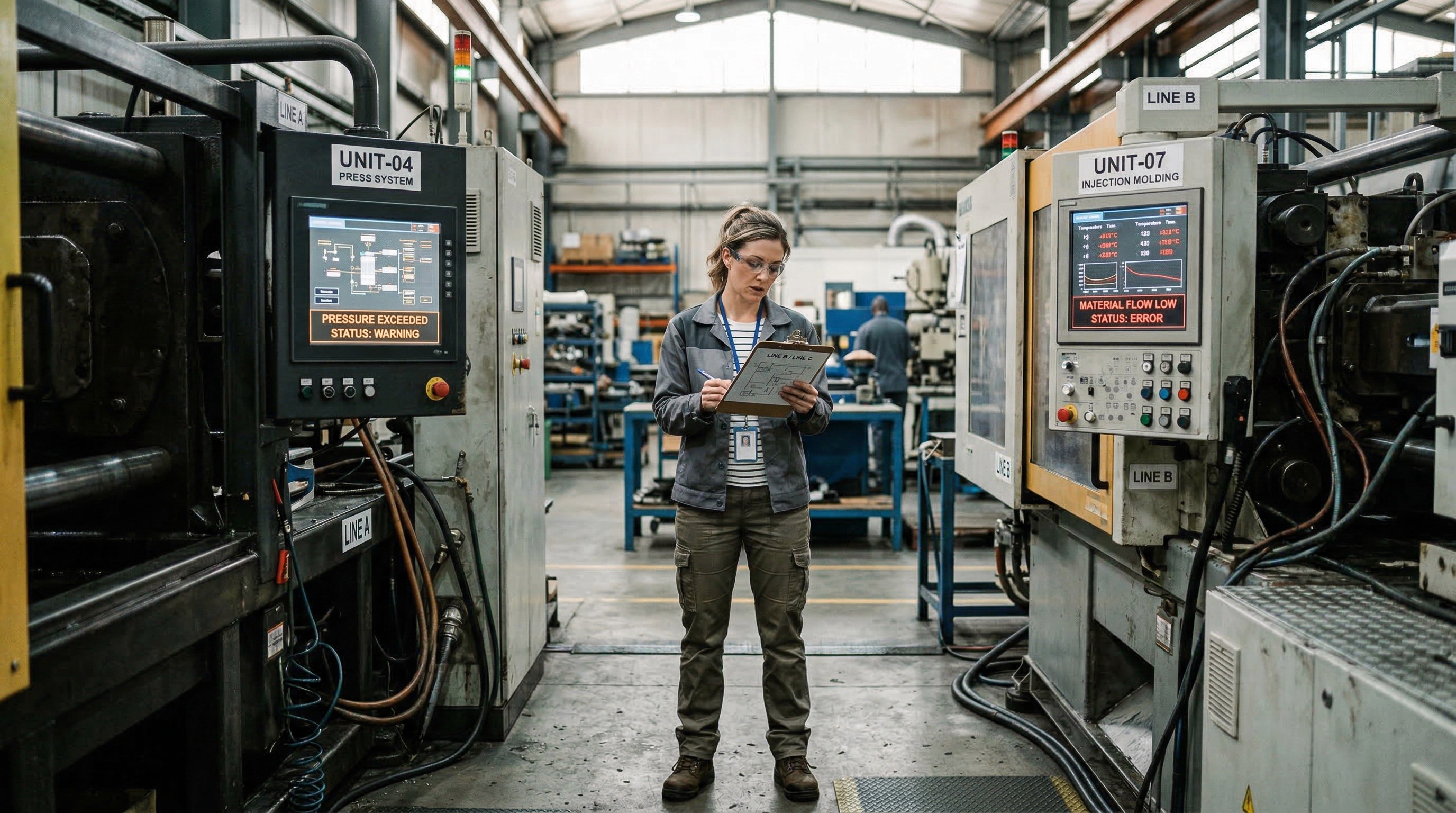
The quality defect detection model performs excellently in testing. It identifies 94% of out-of-tolerance parts in the validation dataset. The team is proud of it. Management has approved the deployment budget.
Three months later, it's running in production with half its inputs missing. The sensor data from Line 3 doesn't reach it in real time because the MES and the AI platform use different data schemas. The ERP's quality records are updated in batch every four hours, so the model is making decisions on information that is sometimes five hours old. The maintenance history it was supposed to use for contextualisation is stored in a separate CMMS that nobody connected.
The model still performs well on the data it can see. But it can only see a fraction of what it needs.
This is the most common failure mode in manufacturing AI. Not bad models. Bad integration.
The Numbers Behind the Problem
The Redwood Software Manufacturing AI and Automation Outlook 2026, based on responses from 520 manufacturing organisations, found that 78% of manufacturers have automated less than half of their critical data transfers. The same research found that automation consistently stalls at system boundaries — the points where data must move between an ERP, an MES, a quality management system, a SCADA platform, and a planning layer.
IDC's 2026 Manufacturing FutureScape predicts that by 2027, 40% of all operational data will be integrated across applications and platforms autonomously due to AI agents purpose-built for specific data flows. The ambition is real. But in 2026, most manufacturers are still reconciling data manually at these boundaries, or not reconciling it at all.
The practical consequence is that AI systems in manufacturing are running on partial information, with delayed updates, from siloed sources that were never designed to talk to each other. The outputs are correspondingly unreliable.
Why the Integration Problem Is Structurally Hard
Manufacturing technology environments typically have three to four layers of systems that accumulated over decades without integration as a design principle.
At the business layer, there is typically an ERP — SAP, Oracle, Infor, or a vertical-specific system. It holds the financial, procurement, and inventory records. It was not designed to receive data in real time from production systems.
At the operational layer, there is an MES — a manufacturing execution system that manages production orders, tracks work-in-progress, and records quality outcomes. It was designed to run on the plant floor, not to share data easily with enterprise systems.
At the machine layer, there are PLCs, SCADA systems, and sensors. They produce data at high frequency in formats that were defined by equipment vendors, not by enterprise IT teams.
And increasingly, there are separate quality management systems, CMMS platforms, energy monitoring tools, and supply chain visibility layers that sit alongside all of the above.
Each of these layers has its own data model, its own update frequency, and its own access control structure. Integrating them requires not just technical connectivity but semantic alignment — agreeing on what the same entity (a production order, a part number, a quality parameter) means across systems that use different identifiers and different schemas.
This is not a problem that AI solves. It is a problem that must be solved before AI can work.
The Two Approaches That Work
Deploy AI inside the system that already has the data
The most reliable path to value in manufacturing AI is to deploy the AI capability inside a system that already holds the relevant data in a consistent format, rather than building integrations to bring data to a new AI platform.
A predictive maintenance model that runs inside the ERP against historical maintenance records and production schedules operates on data that is already clean, already structured, and already updated according to the ERP's normal cadence. It may not have access to sensor-level granularity, but it has reliable, complete data for the use case it was designed to address.
This approach produces less impressive demos. The models have fewer inputs and narrower scope. But they run reliably in production because they don't depend on integration infrastructure that hasn't been built.
Build the integration layer first, as a project in its own right
For manufacturers who need the full picture — who genuinely need sensor data, MES records, and ERP history to be simultaneously available to an AI system — the integration layer needs to be treated as a first-class project, not a prerequisite that gets addressed alongside the AI build.
This means dedicating engineering resource to data pipeline development, semantic harmonisation, and real-time connectivity before the AI model is built. It means accepting that the integration project will take longer and cost more than the model development project.
Organisations that have built this way report that the integration investment pays dividends beyond the AI use case it was originally built for. A well-constructed data integration layer becomes infrastructure that accelerates subsequent AI deployments, because the hard work of getting data into a consistent, accessible form has already been done.
The Strategic Implication
Deloitte's 2025 smart manufacturing survey of 600 executives found that manufacturers are prioritising advanced production scheduling, execution systems, and quality management as their top investment areas for the next two years. These are precisely the use cases where the integration problem is most acute.
The manufacturers who will extract the most value from these investments are those who treat data integration as a strategic infrastructure question, not a technical prerequisite to be solved cheaply. The gap between the ERP, the MES, and the shop floor is not a gap that AI fills. It is a gap that must be filled before AI can deliver on its promise.
Share
Subscribe for updates
Stay updated with the latest product news and exclusive behind-the-scenes insights.