

Blog
Enterprise Strategy
The Pilot Graveyard: Why 70% of Enterprise AI Projects Never Reach Production
Most enterprise AI projects die between proof-of-concept and production. This is a forensic breakdown of why — and what the 30% that make it do differently.
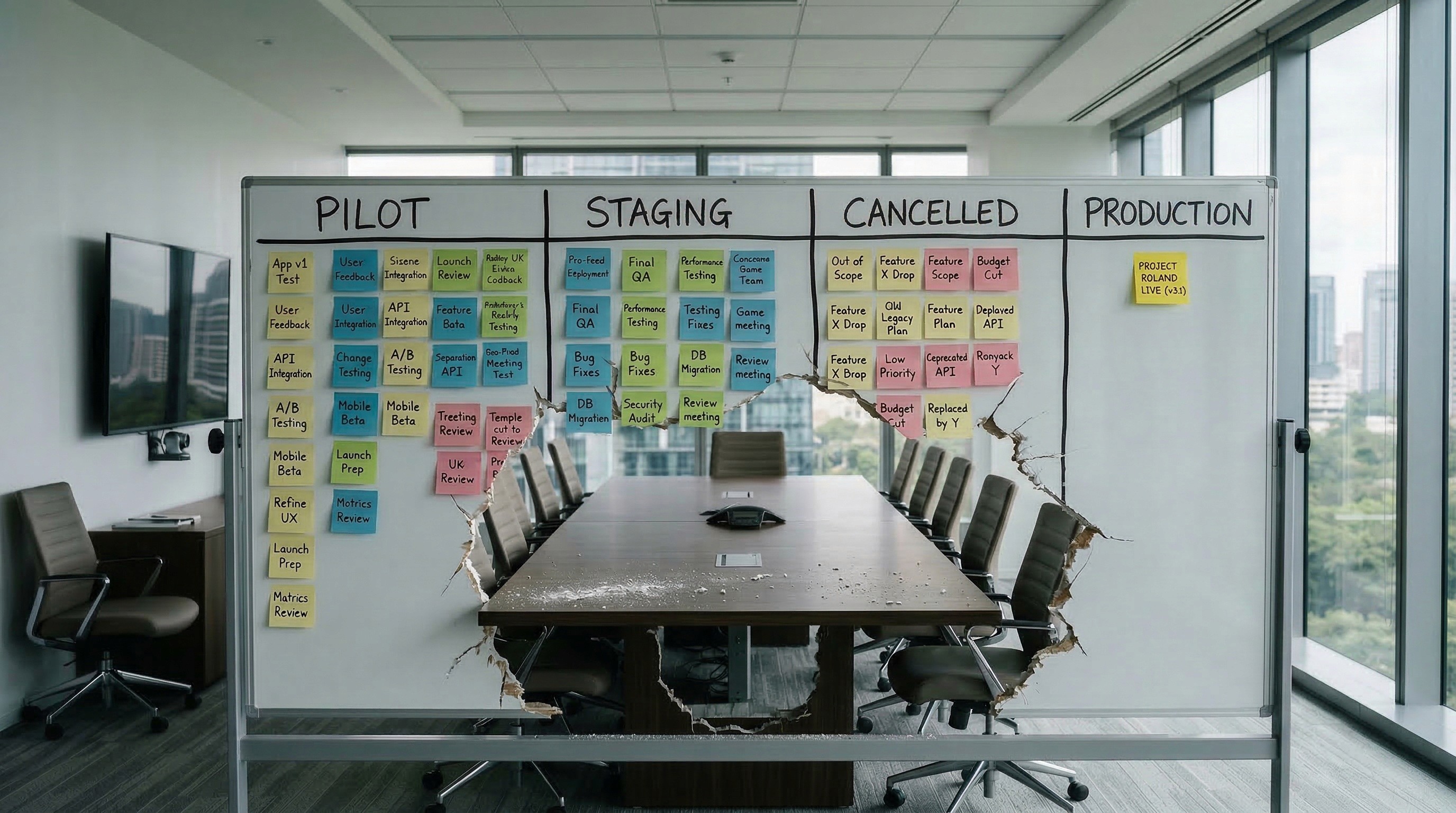
The Pilot Graveyard: Why 70% of Enterprise AI Projects Never Reach Production
Every year, enterprises spend millions on AI initiatives that never make it past the demo stage. McKinsey's 2025 State of AI survey puts the number in stark terms: two-thirds of companies remain stuck in experimentation or pilot phases. Only 39% report that AI has materially affected their earnings — and most of those report less than a 5% EBIT impact.
This is not a technology problem. The models work. The problem is everything that surrounds them.
Why Pilots Feel Like Progress But Aren't
A pilot is designed to answer one question: can this work in our environment? It is not designed to answer the harder questions: who owns this in production? How does it integrate with the ERP? What happens when it gives a wrong answer? Who retrains it when the underlying data changes?
Most organisations answer the first question with a proof-of-concept built on a clean data extract, a dedicated data scientist, and an enthusiastic business sponsor. The pilot succeeds. Then it hits the organisation.
The data scientist moves on. The clean extract isn't how the real data looks. The business sponsor gets promoted and their replacement has different priorities. The IT team raises security concerns about the cloud dependency. The compliance officer wants an audit trail that nobody built.
The pilot doesn't fail because AI doesn't work. It fails because the organisation was never actually prepared to operate AI — only to evaluate it.
The Five Structural Reasons Pilots Die

1. The data was cleaned for the demo, not for production
Pilots almost always run on a curated extract. Someone spent three weeks cleaning four years of transaction history to make the model perform well in the presentation. In production, that same model receives raw, inconsistent, incomplete data from a live ERP. Performance degrades. Confidence falls. The project gets deprioritised.
The 30% that make it treat data quality as a first-class engineering problem from day one — not a pre-demo cleanup task.
2. There is no workflow integration — only a dashboard
The most common failure mode in enterprise AI is building a model that produces correct insights that nobody acts on. The output lives in a separate dashboard. The sales team has to log into something new. The operations manager has to remember to check it. Within six weeks, usage drops to zero.
Production AI lives inside existing workflows. It surfaces insights in the system people already use every day — the ERP, the CRM, the field service app. If adoption requires behaviour change, the project will fail.
3. Governance was an afterthought
When AI makes a recommendation that turns out to be wrong — and it will — someone needs to be accountable. What was the model trained on? Who approved its deployment? What override mechanisms exist? If these questions don't have clear answers before go-live, the first significant error becomes a political crisis that kills the project.
Organisations that scale AI treat governance as an architecture decision, not a compliance checkbox. Model documentation, decision logging, human override requirements, and retraining schedules are built in from the start.
4. KPIs were defined around the model, not the business outcome
Pilots typically measure accuracy, precision, recall — model metrics. Business leaders don't care about F1 scores. They care about revenue protected, costs reduced, hours saved, incidents prevented.
The projects that reach production are built around a single clear business metric from day one. Not "the model achieves 89% accuracy" but "churn detection fires 43 days before the customer's last order, giving the sales team time to intervene."
5. There was no operator — only a builder
Building an AI system and operating one are completely different disciplines. The team that builds the pilot is usually a data science project team. They are not structured to monitor model drift, retrain on new data, handle edge cases in production, or manage the support tickets that emerge when the system behaves unexpectedly.
Scalable AI deployments have an operator — someone accountable for the system's performance in production, not just its initial delivery.
What the 30% Do Differently
Deloitte's 2026 AI survey found that organisations where senior leadership actively shapes AI governance achieve significantly greater business value than those delegating the work to technical teams. McKinsey found that high-performing organisations are three times more likely to have executives who demonstrate real ownership — not just sponsorship — of AI initiatives.
The pattern is consistent across industries:
They start with a specific, measurable business problem — not an AI technology looking for a use case
They insist on integration with existing systems from the design phase, not as a post-launch enhancement
They build governance infrastructure before deployment, not after the first incident
They have a named operator who is accountable for production performance
They measure business outcomes, not model metrics
None of this is technically complex. All of it is organisationally demanding.
The Question Worth Asking Before the Next Pilot
Before signing off on another proof-of-concept, executives should ask a different set of questions.
Not: can this AI model solve our problem in a controlled environment?
But: do we have the data infrastructure, workflow integration, governance framework, and operational accountability to run this in production for the next three years?
If the answer is no — and for most organisations, it is — the project isn't ready to start. It's ready to be designed properly.
The pilot graveyard is full of technically successful experiments that organisationally failed. The difference between them and the 30% that make it isn't better algorithms. It's better operating models.
Share
Subscribe for updates
Stay updated with the latest product news and exclusive behind-the-scenes insights.